

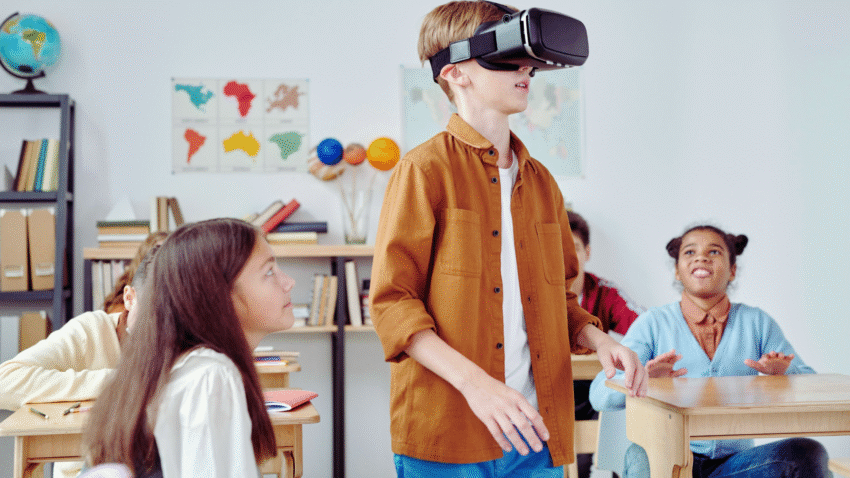
Virtual reality (VR) technology is revolutionising the landscape of education and training. By creating immersive environments, VR allows learners to engage with material in a way that traditional methods cannot replicate. The use of virtual reality in education enhances student engagement and retention, making complex subjects more accessible and enjoyable.
In training scenarios, VR offers a risk-free way to practice skills that may be dangerous or impractical in real life. Professionals can simulate high-pressure situations, gaining experience and confidence before entering the field. As a result, VR provides a transformative approach to skill acquisition across various industries.
Educators and trainers are increasingly recognising the potential of VR to cater to diverse learning styles. Interactive simulations can accommodate visual, auditory, and kinesthetic learners, fostering a more inclusive environment. This innovative tool is set to reshape educational practices, paving the way for a future where learning is both effective and engaging.
The Evolution of Virtual Reality in Education and Training
Virtual reality (VR) has significantly transformed education and training through its historical development and technological advancements. The integration of artificial intelligence (AI) has further enhanced VR’s potential, while key innovations in educational technology have shaped modern pedagogical methods.
Historical Development and Technological Advancements
The journey of VR in education began in the 1960s with rudimentary simulations. Early systems such as the Sensorama and the Aspen Movie Map paved the way for immersive experiences. The 1990s saw the introduction of more sophisticated VR platforms, allowing users to interact within computer-generated environments.
By the early 2000s, advancements in graphics and processing power improved accessibility. Institutions began experimenting with VR for training purposes, particularly in fields like medicine and aviation. Today, VR technologies continue to evolve, incorporating high-definition visuals and haptic feedback, making learning experiences more engaging and effective.
The Role of Artificial Intelligence in Virtual Reality
Artificial intelligence plays a pivotal role in enhancing user interaction within VR environments. It enables the creation of adaptive learning systems that respond to individual student needs. AI algorithms can track progress and adjust the difficulty of tasks, allowing for personalised educational experiences.
Moreover, AI-driven VR simulations provide realistic scenarios for training. This is particularly beneficial in sectors such as healthcare, where trainees can practise procedures in a risk-free environment. The integration of AI also facilitates real-time feedback, enhancing learning outcomes through continual assessment.
Key Innovations in Educational Technology
Recent innovations in educational technology have propelled the use of VR in classrooms. Tools like Google Expeditions and Oculus for Business are revolutionising how subjects are taught. These platforms allow students to explore historical landmarks, celestial bodies, and even intricate biological systems virtually.
Additionally, gamification elements are increasingly incorporated into VR lessons, making learning more engaging. Multiplayer environments enable collaborative learning, where students can work together on projects. Such advancements highlight the growing importance of VR in creating immersive and innovative educational experiences, shaping the future of teaching methods.
Benefits and Impact on Learning Outcomes
Virtual reality (VR) significantly enhances education and training by fostering immersive learning experiences. This technology engages students more deeply, supports diverse learning styles, and improves retention through interactive and experiential methods. Each aspect of VR contributes uniquely to learning outcomes.
Immersive Learning and Student Engagement
Immersive learning through virtual reality creates engaging environments where students can interact with content in a dynamic way. By placing learners in realistic simulations, VR captures attention and stimulates interest.
These experiences encourage students to explore and experiment, leading to deeper understanding. For instance, medical students can practice surgeries in a risk-free environment, while history students can virtually visit ancient cities. This level of engagement fosters a connection to the material that traditional methods often lack.
Enhancing Experiential and Interactive Learning
VR enhances experiential learning by allowing students to participate actively rather than passively absorb information. Through interactive scenarios, learners can practise skills in real-time, reinforcing knowledge through hands-on application.
For example, engineering students can simulate building structures and test their designs under various conditions. This form of learning supports critical thinking and problem-solving, as students face real-world challenges within the virtual space. The immediacy of interaction accelerates the learning process and prepares students for practical, real-life situations.
Supporting Diverse Learning Styles
Virtual reality accommodates a range of learning styles by providing varied modalities through which students can engage with content. Visual learners benefit from graphical simulations, while kinesthetic learners can interact physically in a virtual setting.
Auditory learners can access informative audio guides within VR environments, catering to their preferences. This adaptability allows educators to offer personalised learning experiences, ensuring that every student can engage effectively with the material. Such support promotes inclusivity and boosts academic performance across diverse student populations.
Improved Retention and Real-Time Feedback
The immersive nature of VR contributes to better knowledge retention by creating memorable experiences. Studies indicate that students who learn in a virtual environment often retain information longer compared to traditional methods.
Additionally, real-time feedback in VR settings allows students to make immediate corrections and refine their skills. For instance, a language learner can practise conversation with virtual characters and receive instant feedback on pronunciation and grammar. This timely information helps learners adjust their understanding and mastery quickly, enhancing overall educational outcomes.
Applications and Practical Use Cases
Virtual reality’s integration in education and training continues to evolve, providing innovative solutions across various domains. The following sections explore its practical applications in K-12 education, higher education, and corporate training environments.
K-12 Education Implementation
In K-12 education, virtual reality serves as an engaging tool that transforms traditional learning methods. Schools use VR to create immersive educational experiences, allowing students to explore historical sites, dive into the ocean, or travel through the solar system, all within the classroom.
This exposure enhances student engagement and retention of information. Teachers can quickly tailor lessons to a diverse range of learning styles. Additionally, VR platforms offer interactive simulations that promote critical thinking skills and collaboration among peers.
Educational institutions can adopt VR tools to provide hands-on learning opportunities in fields like science, allowing students to conduct virtual experiments safely. The result is a richer educational experience that prepares students for future challenges.
Many school leaders find that buying the hardware is only the first step in a long process. They often need help to figure out how these new tools fit into their existing goals and state standards. This is where educational consulting services help as they create a clear plan for school improvement. These experts look at student data to see if the technology actually helps kids learn better. A third-party review makes sure the school stays on track with its long-term mission. This support helps teachers feel more confident when they use new methods in their daily lessons.
Higher Education Adoption
In higher education, universities increasingly incorporate VR for advanced learning experiences. Programs in medicine, architecture, and engineering benefit notably from VR applications that facilitate practical skills development.
For instance, medical students can practice surgeries in a risk-free environment, refining their techniques before working with real patients. Architecture students can walk through virtual models of their designs, assessing spatial relationships and aesthetics before actual construction.
Many universities collaborate with VR companies to create tailored content that meets specific curriculum goals. This partnership often results in innovative learning modules that keep pace with technological advancements in professional fields.
Corporate and Vocational Training
Corporations utilise virtual reality for vocational training, enhancing employee skill sets in various industries. VR training modules provide simulated environments for team-building exercises, customer service interactions, and equipment operation.
Participants can engage in realistic scenarios that replicate their job functions without the risk of real-world consequences. This approach significantly reduces training costs and time, allowing employees to gain practical experience efficiently.
Additionally, organisations invest in VR to promote health and safety training. Employees can navigate hazardous situations within a controlled environment, ensuring they are well-prepared to handle emergencies on the job. Thus, VR enhances both employee confidence and workplace safety.
VR Technologies and Future Trends
The ongoing evolution of virtual reality (VR) technologies is reshaping educational landscapes. Key advances include the use of simulated environments, the integration with other realities, and enhancements through various technological tools.
Simulated Environments and Interactive Simulations
Simulated environments offer immersive experiences that replicate real-life scenarios. This technology allows learners to engage in practical applications without the risks associated with real-world practice.
For instance, medical students can perform surgeries in virtual operating rooms, receiving instant feedback on their techniques. Similarly, engineering students can interact with complex 3D models to better understand spatial relationships and design principles.
Interactive simulations create dynamic learning experiences that adapt to individual skill levels. These tailored programmes enhance engagement and retention while fostering critical thinking. The ability to manipulate variables and observe outcomes in a controlled setting prepares students for real-world problem-solving.
Integration with Augmented and Mixed Reality
The integration of augmented reality (AR) and mixed reality (MR) into education brings a hybrid approach to learning. AR overlays digital information onto the physical world, enriching learners’ experiences with additional context and interactive elements.
For example, anatomy students can use AR glasses to view 3D models of human organs superimposed on real patients. This interactive feature enhances comprehension and retention of complex structures.
Mixed reality combines both AR and VR to allow users to interact with digital and physical content simultaneously. This fusion creates more engaging, rich, and adaptable learning environments, catering to various learning styles while enhancing collaborative efforts.
Technological Tools: Haptic Feedback and Motion Tracking
Haptic feedback enhances the immersive quality of virtual environments by simulating the sense of touch. This technology allows users to feel tactile sensations while interacting with virtual objects, creating a more authentic learning experience.
In healthcare training, for instance, haptic devices can replicate the resistance and texture of human tissue during surgical simulations. Such realistic feedback is crucial for skill development and helps students make informed decisions in practice.
Motion tracking technology further complements VR education by enabling precise action recognition. Learners can move and interact naturally within the virtual space, promoting kinesthetic learning. This technology captures movement in real time, providing instant feedback and facilitating skill acquisition.
Future Opportunities in Virtual Reality-Enhanced Learning
The future of virtual reality in education appears promising, with emerging possibilities for enhanced learning experiences. As VR technology becomes more accessible, educational institutions are likely to adopt these tools to meet diverse learning needs.
Notable trends include the development of personalised learning pathways powered by artificial intelligence. Customised VR experiences can adapt in real-time based on individual performance data, enhancing learning outcomes.
Furthermore, collaboration between different technologies, such as AI, AR, and VR, holds the potential to create more holistic educational approaches. By integrating these technologies, educators can craft immersive experiences that prepare students for complex real-world challenges.